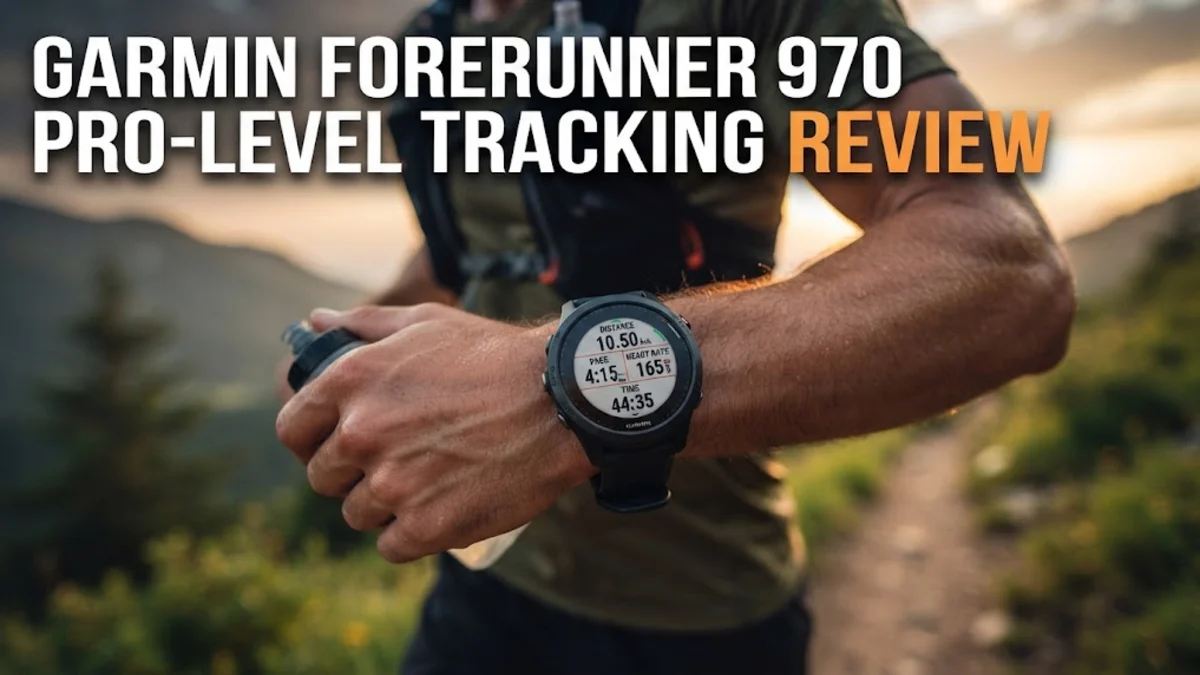
Overview
The Garmin Forerunner 970 arrives as the latest flagship in Garmin's storied line of endurance-focused multisport watches. In a market crowded with smartwatches that prioritize notifications and app ecosystems, the Forerunner 970 takes a different path, doubling down on the metrics that matter most to dedicated runners, cyclists, and triathletes. This is not a device designed for casual fitness tracking; it is a sophisticated training laboratory worn on the wrist. Whether you are a marathon runner chasing a personal best or a triathlete balancing swim, bike, and run training loads, this watch is engineered to provide the data granularity necessary to optimize performance and minimize the risk of overtraining.
By integrating advanced physiological measurements with the robust tracking capabilities that Garmin is famous for, the 970 aims to be the constant companion that keeps your training data front and center. The device manages to bridge the gap between amateur-level fitness trackers and professional-grade performance monitors, ensuring that every mile, every pedal stroke, and every swimming lap is accounted for with clinical precision.
Design and Build
The build quality of the Forerunner 970 is centered on the dual pillars of weight reduction and structural durability. It is constructed from a high-strength, fiber-reinforced polymer that provides a lightweight feel on the wrist—critical for long endurance sessions where even a few extra grams can become noticeable. The bezel, typically reinforced to withstand impact, protects the high-resolution AMOLED screen, which offers a level of color depth and sharpness that makes reading navigation maps and training data fields easy, even in harsh, direct sunlight.
Ergonomics play a vital role in the design of the 970. The watch includes a physical five-button layout, which is highly preferred by endurance athletes over touchscreens alone. This interface ensures that you can start, pause, or switch between data screens even when your hands are wet with sweat or you are wearing gloves. The silicone strap is designed with a specific focus on skin breathability and securing the optical sensor tightly against the wrist, a requirement for high-fidelity heart rate tracking during intense interval training. Despite its rugged construction, the device maintains a low profile, preventing it from snagging on clothing sleeves during long winter runs.
Key Features and Performance
At the heart of the Forerunner 970 experience is the suite of advanced physiological measurements that set it apart from entry-level trackers. The device introduces refined real-time stamina tracking, an algorithm that monitors your output against your calculated physiological ceiling to give you an estimate of how much fuel you have left in the tank. This is particularly useful for middle-to-late stage race efforts, where managing intensity is the difference between hitting a target pace and "bonking."
The multi-band GNSS technology represents a significant leap forward in GPS accuracy. By connecting to multiple satellite frequencies simultaneously, the watch ensures that your path is accurately mapped even when you are navigating through dense urban canyons, shaded mountain trails, or dense forest canopies. Where lesser trackers might see a jumpy path that results in inaccurate pace data, the 970 remains locked on, providing a clean, consistent GPS track that feels trustworthy.
- Advanced training readiness scores that synthesize sleep, recovery, and heart rate variability to guide your daily intensity.
- Full-color topographical mapping that allows for breadcrumb navigation, helping you find your way back to your starting point without needing a phone.
- Integrated music storage with offline compatibility for platforms like Spotify and Deezer, ensuring your workout playlist is always ready even without a data connection.
- Extended battery life that stands out in the AMOLED market, allowing for several days of intensive GPS training without the anxiety of a dying watch battery.
Performance in the field is consistently reported by users as being exceptionally robust. The synchronization with the Garmin Connect ecosystem allows you to delve deep into your long-term training load. The watch automatically categorizes your workouts by aerobic and anaerobic training effect, providing a clear roadmap of which physiological systems your current training plan is improving.
Who It Is For (and Who Should Skip It)
The Forerunner 970 is explicitly designed for the serious athlete. If your goal is to break three hours in a marathon, complete your first Ironman, or consistently hit specific heart-rate zone targets during training, the depth of data provided by this device will be an invaluable asset to your development. It provides the type of feedback loop that turns guesswork into an informed, scientific training cycle.
Conversely, if you are a casual jogger, a weekend walker, or someone who prioritizes smart features like cellular voice calls, deep voice assistant integration, or a massive app store full of non-fitness utilities, the Forerunner 970 may feel like overkill. The steep learning curve associated with its complex settings can be frustrating for those who want a simple, plug-and-play fitness experience. Furthermore, those who prefer the smaller, fashion-oriented aesthetic of entry-level smartwatches may find the functional, performance-first chassis of the 970 a bit too large or utilitarian for daily wear at the office or formal events.
Alternatives Worth Considering
The marketplace for high-end multisport watches is competitive. The Apple Watch Ultra 3 is perhaps the most significant rival, particularly if you are already deeply embedded in the Apple ecosystem. Its cellular capabilities and integration with iOS offer a level of convenience that the 970 cannot match, though it often falls short on pure endurance-focused data analytics and battery longevity. The Polar Vantage V3 is another formidable contender. Polar has long been a leader in heart rate technology and recovery analysis, and the V3 offers a distinct, perhaps more intuitive interface for those who prioritize the science of recovery over pure mapping features.
Lastly, the Suunto Race S presents an compelling case for those who want a premium, rugged build and advanced GPS capabilities at a generally lower price point. While it may not have the same breadth of third-party integration as the Garmin, its specialized outdoor tools are top-tier, making it an excellent alternative for trail runners and mountain explorers who want a dedicated outdoor instrument.
Final Verdict
The Garmin Forerunner 970 remains a standard-bearer for the multisport watch category. By balancing a high-quality AMOLED screen with industry-leading battery efficiency and accurate GNSS tracking, it justifies its premium place in the market. It is a tool for people who treat their training as a serious endeavor, offering the deep-dive analytics needed to measure progress over months and years rather than just days.
While the initial cost is significant and the sheer volume of data can be daunting, the investment pays off for users who actually use the features. The reliability of the hardware, the breadth of the Garmin Connect analytical software, and the focused design all culminate in a device that feels like an extension of the athlete. For those dedicated to reaching the next level in their endurance journey, the Forerunner 970 provides the objective data necessary to ensure that every single training session counts toward that ultimate goal.