Overview
In the expansive market of kitchen appliances, finding a blender that manages to be both budget-friendly and durable is a constant struggle for the average consumer. The Philips blender hr2223 enters this crowded space not as a high-performance laboratory machine, but as a reliable workhorse intended for daily domestic use. This model has gained attention among users who need a machine capable of handling basic blending chores without the steep price tag associated with professional-grade, high-wattage Vitamix or Ninja counterparts. It bridges the gap between basic, low-end stick blenders and high-end processing powerhouses, aiming to serve as the default appliance for your morning routine or light dinner prep.
When you look at the current kitchen landscape, many users are looking for a unit that is "worth it" for basic protein shakes or smoothie bowls. This model specifically targets the segment of the population that is tired of cheap blenders that break within months, but does not want to pay for features they will never use, such as programmable timers or touch-screen interfaces. The hr2223 focuses on the fundamentals: a decent motor, a well-engineered blade assembly, and a functional jar size that accommodates a standard family of two to four people.
Design and Build
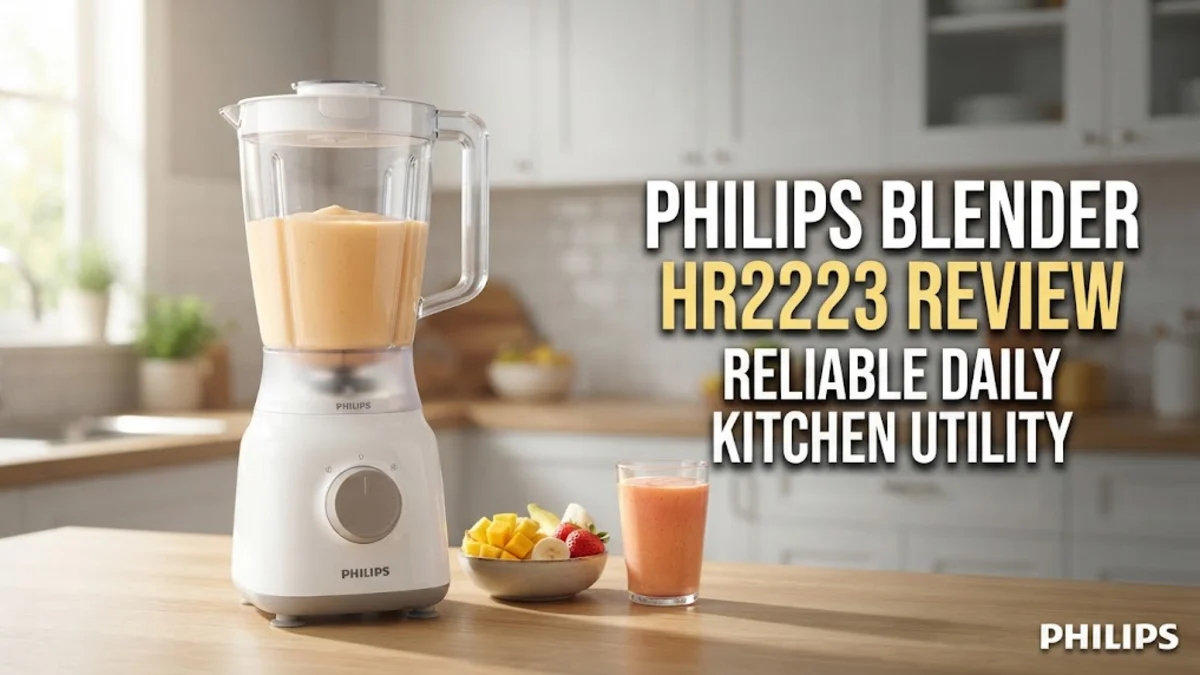
The Philips blender hr2223 carries a design language rooted in traditional, functional kitchen aesthetics. It eschews the aggressive, sharp-angled styling of modern high-speed blenders, opting instead for a friendly, approachable footprint that fits easily under standard kitchen cabinets. The base is crafted from a high-density, matte-finish plastic that is resistant to fingerprints and simple to wipe down with a damp cloth after spills.
The jar itself is constructed from food-grade, BPA-free plastic. While some users prefer glass for its scratch resistance, the plastic jar here offers a significant advantage in terms of weight and durability against accidental drops. You can comfortably handle the jar even when it is filled with liquid, as the handle is ergonomically contoured for a secure grip. The lid seals tightly, preventing the messy splatters often associated with budget blenders, and includes a removable measuring cap that allows you to safely add ingredients while the machine is running.
Regarding the blades, Philips uses a proprietary ProBlend technology. This is not just a standard four-prong blade; it is specifically shaped to create an vortex effect, pulling ingredients down towards the center of the jar. This is essential for ensuring that you do not end up with chunky, unblended fruit floating at the top of your smoothie. The build quality of the base unit feels solid, with rubberized suction-cup feet that anchor the machine firmly to your countertop, preventing it from 'walking' across the surface when you hit the high-speed setting.
Key Features and Performance
The performance of the hr2223 is characterized by consistency. It features a multi-speed dial that gives you manual control over the blending process. Many lower-end blenders only offer a single 'on' button, which leaves you guessing about the texture. With the hr2223, you can start at a low speed to break down larger chunks before ramping up to high speed for a smooth finish.
For the average user, the day-to-day use cases are quite clear: breakfast smoothies, healthy protein shakes, salad dressings, and liquid-based soups. If you are making a smoothie with fresh fruit like strawberries, bananas, and yogurt, this blender performs admirably. It creates a smooth, uniform texture in roughly 45 to 60 seconds. The pulse function is particularly useful when you need to break down harder ingredients in short bursts, which prevents the motor from overheating.
In terms of food processing, it is highly capable for light tasks. You can use it to create quick garlic and herb sauces, breadcrumbs, or pancake batters without needing to drag out a dedicated food processor. However, it is important to understand the mechanical limits here. This machine is not built to dry-grind coffee beans or pulverize fibrous kale and spinach into a completely microscopic, liquified paste. If your diet is heavy on "green smoothies" that require massive amounts of hard, leafy greens to be shredded into nothingness, you might find that the bits of fiber remain noticeable.
Regarding ice, the machine handles standard, tray-based ice cubes well. It is not designed for industrial amounts of frozen fruit or huge blocks of ice. If you are a fan of thick, frozen margaritas or dense smoothie bowls, you will need to add a splash of liquid—water, juice, or milk—to help the blades cycle the frozen mass properly.
Who It Is For (and Who Should Skip It)
The Philips blender hr2223 is tailor-made for the home cook who has a practical approach to cooking. It is perfect for a student, a young professional, or a small family that wants a blender for simple, quick, and efficient food preparation. If you value a machine that is ready to go in seconds, is easy to clean, and does not demand a long learning curve to master, this is a strong contender.
You should consider buying this model if: 1. You make morning smoothies 3-4 times a week. 2. You have a small kitchen and need to store the blender in a cupboard when not in use. 3. You prefer manual control over smart presets. 4. You are tired of cleaning complicated multi-piece blade assemblies.
Conversely, you should skip this model if: 1. You are a serious 'raw food' enthusiast who needs to grind nuts, seeds, and tough roots daily. 2. You are looking for a blender that can replace a food processor for chopping vegetables or kneading dough. 3. You require a commercial-grade motor that can run for 10 minutes at a time without breaking a sweat. 4. You prioritize the heavy, premium feel of glass or stainless steel over the practicality of lightweight, shatter-resistant plastic.
Alternatives Worth Considering
The blender market is crowded, and your specific needs might align better with other models. If you prioritize extreme portability, a personal blender like the ones found in the Ninja Nutri-Blender line might be better, as they allow you to blend directly in the cup you drink from. This eliminates the need to clean a large pitcher when you are only making one serving.
If you are comparing it against the Hamilton Beach Power Elite, you will find that the Hamilton Beach model often competes on a similar price point but sometimes features a more simplified, button-based control panel. The Philips hr2223 feels slightly more refined in its build and usually offers better motor cooling for standard domestic tasks. If you are willing to spend significantly more, the Oster Pro 1200 offers a more powerful motor and, in some bundles, a glass jar, though it has a larger physical footprint on your counter.
Final Verdict
The Philips blender hr2223 manages to hit the sweet spot for the vast majority of consumers who do not require professional equipment. By focusing on essential features rather than chasing unnecessary tech trends, it delivers a high value proposition. It is a workhorse that takes the hassle out of basic blending tasks. While it has clear physical limitations—it will not replace an expensive, high-speed blender—it is significantly more reliable and better designed than the ultra-cheap, generic units you might find in a bargain bin.
The combination of a well-balanced blade system, sturdy, compact design, and straightforward controls makes it an excellent addition to the average home kitchen. If you maintain it properly by rinsing the blade assembly after each use and not overfilling the jar with frozen ingredients, this blender is likely to become one of the most frequently used appliances in your household.