Overview
In a market currently saturated with power banks boasting massive capacities, multi-port output arrays, and complex digital displays, the Goal Zero Flip 36 stands out by adhering to a "less is more" philosophy. This device is not designed to power your laptop or provide off-grid power for a week; rather, it is a dedicated companion for your daily carry or light weekend excursions. Goal Zero, a company with deep roots in the portable solar and off-grid power sector, has channeled its engineering expertise into creating a device that favors physical robustness and ease of use over technical specifications that only power users might need.
When you are navigating through a busy work day or trekking on a local hiking trail, the last thing you want is a heavy, cumbersome battery pack that requires a tangle of proprietary cables. The Flip 36 is specifically designed to eliminate those friction points, offering a refined, minimalist charging solution that fits into your pocket or bag without feeling like a burden. By focusing on the fundamentals—reliable energy storage and simplified charging mechanics—the brand provides a consistent experience for the average smartphone user who simply needs to avoid the dreaded "low battery" notification at the worst possible time.
Design and Build
The aesthetic of the Goal Zero Flip 36 is purely utilitarian. It features a slim, rectangular design that sits comfortably in the palm of your hand, with a texture that is intentionally engineered for grip. Unlike many generic plastic power banks that feel slick or flimsy, this unit possesses a structural integrity that suggests it can withstand the rigors of travel. The outer casing is finished with high-quality, impact-resistant materials that resist minor scuffs and impacts, making it a reliable choice for outdoor enthusiasts who might be storing it in a backpack pocket alongside harder gear.
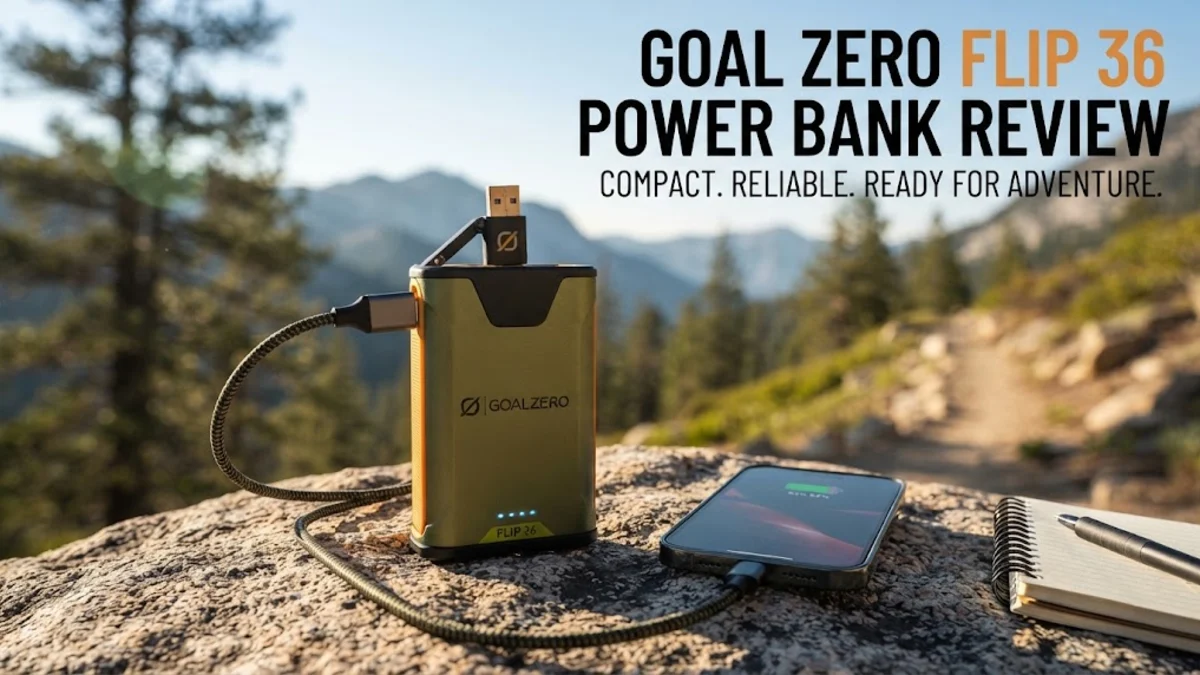
The defining design element of this power bank is undoubtedly the integrated, flip-out USB-A input plug. This clever piece of mechanical engineering completely removes the need to carry a separate micro-USB cable just for charging the power bank itself. You can pull this connector out, insert it into any standard wall charger, laptop port, or solar panel, and let it draw power. This feature alone solves a major frustration point for travelers: losing or forgetting the specific, often short, charging cable that came with your battery pack. The hinge mechanism on the flip-out connector is designed to be durable, maintaining its position firmly whether it is stowed away or actively plugged into a power source.
On the front, you will find a set of intuitive LED light indicators. These are not just for show; they provide a clear, real-time snapshot of how much charge remains in the 10,000mAh lithium-ion cell. With a simple push of the button, you can verify if you are at full capacity before embarking on an outing, ensuring you are never caught unprepared. The simplicity of this interface means that even in low-light conditions, such as inside a tent or a dim room, you can read the status of your battery without needing an app or a complex display.
Key Features and Performance
At its heart, the Flip 36 houses a 10,000mAh battery. In the current mobile ecosystem, this is considered the "sweet spot" for a balance between capacity and portability. For most modern smartphones, this capacity translates into approximately two to three full charges, which is sufficient for a long day of intensive use or a two-day excursion where you are only charging your device at night. The power output is routed through a single USB-A port that is optimized for efficiency.
It is important to acknowledge the trade-offs regarding charging speed. The Flip 36 does not incorporate modern high-speed Power Delivery (PD) protocols or high-voltage fast charging found in flagship-tier power banks. It outputs at standard 5V/2.1A levels, which is perfectly adequate for charging smartphones, Bluetooth headphones, earbuds, and small handheld GPS units. While this may be slower than the rapid-charging technology found on some modern handsets, it is remarkably gentle on the battery health of your devices, producing less heat during the charging cycle. This makes it an exceptionally safe and reliable choice for older smartphones or sensitive electronic accessories that might be damaged by aggressive high-voltage charging standards.
The power bank handles pass-through charging effectively, allowing you to top off the battery while simultaneously providing power to your peripheral. This is particularly useful when you are in a location with limited outlet space, such as a coffee shop or a hotel room, allowing you to charge both your power bank and your device through a single wall socket. The safety systems built into the circuitry include protection against overcharge, over-discharge, and short-circuiting, providing you with the peace of mind that your expensive electronics are safeguarded during the replenishment process.
Who It Is For (and Who Should Skip It)
This power bank is ideal for the casual commuter who needs an emergency backup for their phone during long transit days, and for the outdoor hobbyist who appreciates a lightweight gear kit. It is also a perfect entry-level device for those who find the "all-singing, all-dancing" portable power stations to be too bulky and unnecessary for their needs. If your electronic ecosystem consists of a phone, a watch, and maybe a pair of wireless earbuds, this is exactly the tool for the job.
Conversely, you should skip the Flip 36 if your daily requirements include charging a laptop, a tablet with high power requirements, or multiple devices simultaneously. The lack of a high-wattage USB-C port means it will not trigger "fast charging" on newer smartphones, and if you are used to the instantaneous power of a 65W or 100W GaN charger, the slower output speed of this bank might feel like a downgrade. Furthermore, if you are looking for a device that offers wireless charging or advanced features like pass-through data transfer, you would be better served looking at more specialized models.
Alternatives Worth Considering
When comparing this to competitors like the Anker PowerCore series, you are weighing the convenience of the flip-out plug against the raw power delivery of the competition. Many Anker units include dual output ports, which allows you to charge two devices at once, a feature the Flip 36 lacks. If your lifestyle involves charging both a phone and a secondary device like a digital camera or a secondary phone at the same time, that dual-port flexibility is a significant advantage.
Another alternative is the Jackery Bolt, which differentiates itself by including built-in lightning and micro-USB cables. For users who hate cable management entirely, that might be a more attractive design than the Goal Zero approach. However, the Goal Zero Flip 36 typically holds a slight edge in terms of perceived build quality and the simple, robust nature of its internal cell, which many users find performs more consistently over a period of years rather than months.
Final Verdict
The Goal Zero Flip 36 excels because it embraces its identity. It does not pretend to be a portable powerhouse for high-demand gear; it positions itself as the dependable, indestructible brick that will keep your essentials running. For those who prioritize a low-stress experience—where you simply pull the device out, plug it in, and know it will work every single time—it is a fantastic investment. Its construction is reliable, its capacity is practical for the vast majority of users, and its integrated plug design remains one of the best ideas in the portable power space. While it may not satisfy the technical requirements of a power user looking for the fastest possible charging speeds, it earns its place in a backpack, purse, or emergency kit as an essential, high-quality tool.