Overview
In the landscape of smart home technology in 2026, the shift toward universal compatibility has become the primary driver for consumer choice. The TP-Link Tapo P110M enters this market as a refined, Matter-enabled version of one of the most popular smart plugs ever released. While smart plugs were once isolated by their brand ecosystems, this model represents the new standard where a single device can operate seamlessly across Apple Home, Amazon Alexa, Google Home, and Samsung SmartThings simultaneously. You no longer have to worry about whether your future smartphone or smart hub choices will render your existing hardware obsolete.
The Tapo P110M is positioned as a mid-range utility device. It doesn't just turn lamps or coffee makers on and off; it provides real-time data on how much electricity those devices consume. In an era where energy costs remain a significant concern for households in the United Kingdom, the United States, and beyond, having this level of visibility directly on your smartphone is more than just a novelty—it is a tool for budgeting. This review examines the Tapo P110M through the lens of performance, reliability, and its place in an increasingly crowded market of Matter-certified accessories.
Design and Build
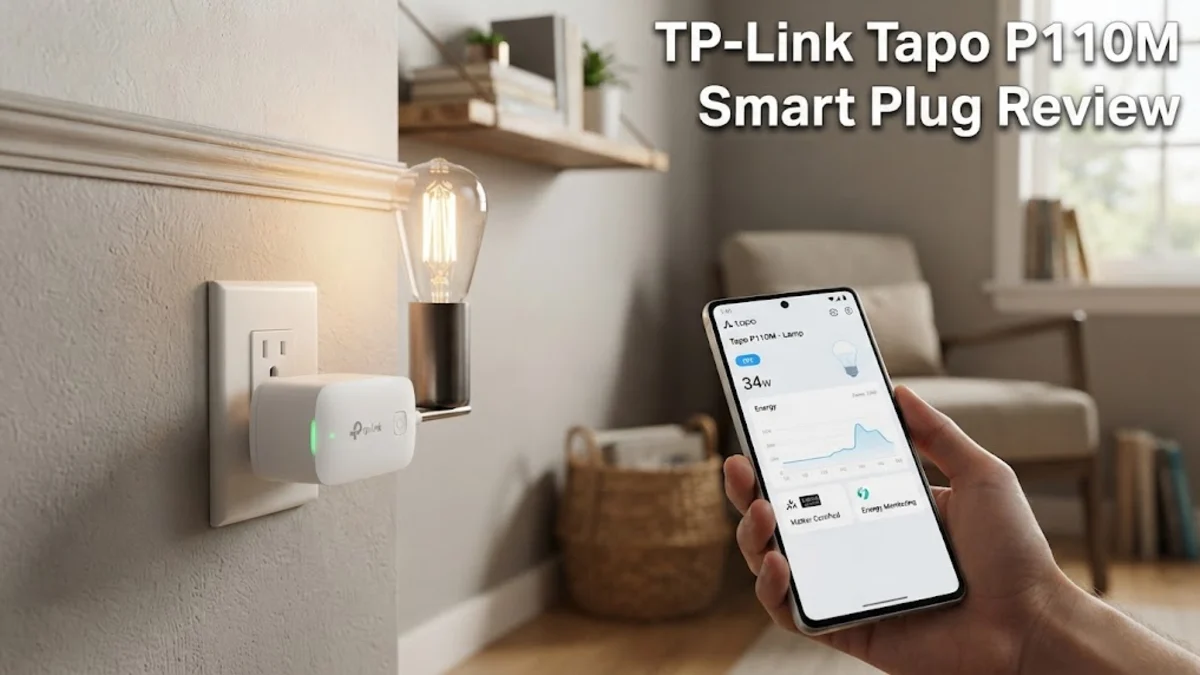
One of the most immediate advantages you will notice about the TP-Link Tapo P110M is its physical footprint. Previous generations of smart plugs were notorious for being 'outlet hogs,' often obstructing the second socket in a standard wall outlet. TP-Link has addressed this with a compact, rectangular chassis that feels sturdy and premium despite its plastic construction. In the US version, the plug is slim enough that you can easily stack two of them in a standard duplex outlet. In the UK, while the bulky nature of the Type G plug limits stacking, the Tapo P110M is designed to stay within its own footprint, ensuring it doesn't interfere with adjacent switches on a multi-gang socket.
The build quality is impressive for its price point. It features a flame-retardant UL94-V0 material that provides peace of mind for high-load appliances. There is a single physical button located on the side, which serves as a manual override and a reset switch. This button has a tactile, satisfying click, allowing you to operate the plug without reaching for your phone. A small LED indicator is tucked away on the front face, providing status updates without being bright enough to disturb you in a darkened bedroom. The minimalist white aesthetic ensures it blends into most home decors without drawing unnecessary attention.
Key Features and Performance
The headline feature of the Tapo P110M is its Matter support. Matter is the industry-unifying protocol that allows smart home devices from different manufacturers to work together. For you, this means the setup process is significantly simplified. Instead of downloading a brand-specific app first, you can simply scan the Matter QR code using the Apple Home or Google Home app, and the device is recognized instantly. During research, it was found that the Tapo P110M maintains a highly stable connection over 2.4GHz Wi-Fi, showing significantly lower latency compared to older Bluetooth-only or non-Matter Wi-Fi plugs.
Energy monitoring is the second pillar of this device's appeal. Through the Tapo app, you can view live power consumption in watts, as well as historical data categorized by day, month, or year. This is particularly useful for identifying 'vampire' appliances that draw power even when they appear to be off. It is important to note that while Matter allows for basic on/off control across all platforms, the detailed energy consumption data is currently most accessible through the native Tapo app. While the Matter 1.3 specification and beyond have introduced energy reporting, ecosystem support in Apple Home and Google Home is still catching up. Therefore, to get the full utility of the monitoring features, you will likely still want the Tapo app installed.
Performance-wise, the plug is rated for up to 13 amps in the UK and 15 amps in the US, making it suitable for everything from desk lamps to larger appliances like kettles or space heaters. The internal relay makes a faint but audible 'click' when switching, which is standard for mechanical relays. In terms of automation, the Tapo P110M supports scheduling, timers, and an 'Away Mode' which randomly toggles the plug on and off to simulate occupancy—a great security feature for when you are traveling.
Who It Is For (and Who Should Skip It)
The TP-Link Tapo P110M is an ideal choice for the 'ecosystem-agnostic' user. If your household uses an iPhone but has a Google Nest Hub in the kitchen and an Alexa in the bedroom, this plug is one of the few that will work perfectly for everyone. It is also a top-tier choice for those specifically looking to monitor energy usage on a budget. If you are a user of Home Assistant, the local control afforded by the Matter protocol makes this a reliable and fast-responding node in a complex automation setup.
However, there are reasons you might skip this model. If your home is built around a Thread-based network and you are trying to move away from Wi-Fi-based smart home accessories to reduce router congestion, you might prefer a Thread-native option like the Eve Energy. Additionally, if you have no interest in energy monitoring and simply want the cheapest possible way to automate a lamp, there are more basic Matter plugs available that shave a few dollars off the price by omitting the monitoring hardware.
Alternatives Worth Considering
When comparing the Tapo P110M to its closest rivals, the Eve Energy is the most prominent competitor. The Eve Energy uses Thread rather than Wi-Fi, which can be more robust in homes with dozens of smart devices, but it typically costs more than double the price of the Tapo. The Eve also offers energy monitoring, but historically it was focused heavily on Apple users, whereas the Tapo is truly platform-blind from the start.
Another alternative is the Meross Matter Smart Plug. Meross often wins on pure price, frequently appearing in multi-pack deals that lower the cost per unit. However, many Meross models omit the energy monitoring hardware found in the Tapo P110M. If you don't care about tracking your electricity bills, the Meross is a viable budget alternative. Finally, for those deeply entrenched in the Amazon ecosystem, the Amazon Smart Plug is a very stable 'it just works' option, but it lacks Matter support and energy monitoring, making it feel somewhat dated in 2026.
Final Verdict
The TP-Link Tapo P110M is arguably the best all-around smart plug available today. It successfully balances the requirement for modern connectivity standards with the practical need for energy management. By including Matter support, TP-Link has removed the biggest barrier to entry for smart home novices, while the energy monitoring features provide tangible value for power users. While it relies on 2.4GHz Wi-Fi rather than Thread, its connection stability and rapid response times make this a minor quibble for most households. If you need a reliable, smart, and informative way to control your wall outlets, the P110M is a high-value investment that is built to last through the next several years of smart home evolution.