Overview
In the 2026 smart home landscape, the conversation has shifted decisively away from the 'subscription trap.' As more consumers grow weary of recurring monthly fees just to access their own video footage, brands that prioritize local storage and high-fidelity hardware have seen a significant surge in popularity. The Reolink Video Doorbell WiFi has emerged as a cornerstone of this movement. While industry giants often lock their best features—like person detection and rich notifications—behind a paywall, this device offers a complete security package for a one-time purchase price. Research into its specifications reveals a device designed for the enthusiast, yet accessible enough for the average homeowner. It balances a high-resolution 5MP sensor with versatile connectivity options, including dual-band WiFi and support for third-party platforms like Home Assistant and Blue Iris. Unlike many competitors that rely on the cloud for processing, this doorbell handles its AI-driven detection locally, ensuring faster response times and enhanced privacy.
Design and Build
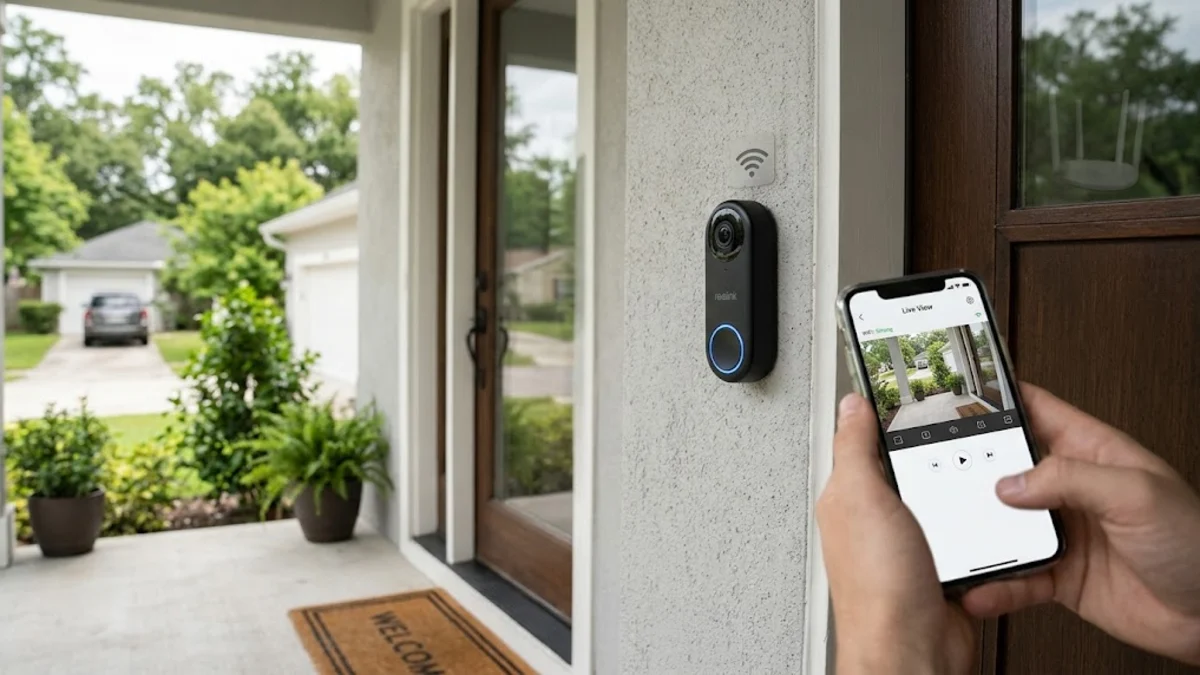
The design of the Reolink Video Doorbell WiFi follows a functional, utilitarian aesthetic that deviates from the rounded, pebble-like shapes of some competitors. It is a vertical, rectangular unit with a sophisticated matte black finish. Measuring approximately 5.2 x 1.9 x 0.9 inches, it is somewhat larger than a standard traditional doorbell but remains slim enough to fit on most door frames. The front face is dominated by a large camera lens at the top and a prominent, circular call button at the bottom, which is encircled by a subtle LED status light. The build quality is reported by users to be solid, though the housing is primarily constructed of high-density plastic rather than metal. One notable design choice is the inclusion of a 15-degree wedge mount in the box, allowing for better positioning if your doorbell is located on a side wall. The device is IP65-rated for weather resistance, making it suitable for most climates, though users in extreme environments should ensure it is shielded from direct, heavy downpours. A key component of the package is the included wireless chime, which plugs into any standard wall outlet and syncs with the doorbell via a 433MHz signal, ensuring you hear the bell even if your phone is silent or your WiFi is temporarily down.
Key Features and Performance
Performance is where the Reolink Video Doorbell WiFi truly distinguishes itself. While most doorbells in 2026 still linger at 1080p or '2K' (typically 4MP), Reolink utilizes a 5MP sensor that captures video at a resolution of 2560 x 1920. This 4:3 aspect ratio is particularly beneficial for a front door, as it provides a taller field of view that allows you to see both the faces of visitors and packages left on the ground. Research indicates that the clarity of the daytime footage is exceptional, with enough detail to read license plates on the street or identify small text on delivery uniforms. Night vision is handled by high-power infrared LEDs, which provide a clear black-and-white image without the 'blown-out' effect often seen when visitors stand too close to the lens. A standout feature is the 6-second pre-roll. Because the device is hardwired, it is constantly recording to a temporary buffer; when motion is detected, the saved clip includes the six seconds of action leading up to the event, providing vital context that battery-powered doorbells often miss. For storage, the device includes a microSD card slot supporting up to 256GB, but it can also stream footage directly to a Reolink NVR or a private NAS (Network Attached Storage) system via ONVIF and RTSP protocols. This level of openness is rare in the current market and makes it a favorite for those who want to build a unified, local-only security network.
Who It Is For (and Who Should Skip It)
This doorbell is a primary candidate for 'prosumers' and privacy-conscious users. If you are someone who enjoys tweaking settings, integrating devices into a broader smart home ecosystem like Home Assistant, or simply wants to avoid the 'tax' of a monthly subscription, this is likely your best option. It is also excellent for homeowners who already have an existing doorbell wire (12-24V AC or 24V DC) and want a high-performance upgrade. However, it is not for everyone. Since it lacks an internal battery, it is not suitable for renters who cannot modify their wiring or for homes where running a power cable to the door is impossible. Furthermore, while the Reolink app is powerful and functional, it lacks some of the 'polished' AI features found in Google or Amazon ecosystems, such as facial recognition for specific family members. If you prioritize a simplified, 'set-it-and-forget-it' experience and don't mind the subscription fees, the ease of use offered by Ring or Nest might be more appealing.
Alternatives Worth Considering
When evaluating alternatives, the Eufy Video Doorbell E340 is the most direct competitor. Like the Reolink, it offers local storage and no monthly fees, but it adds a second downward-facing camera specifically for package monitoring. However, the Eufy often comes with a higher price tag and a slightly more restrictive ecosystem. For those who are already deeply invested in the Amazon Alexa ecosystem, the Ring Video Doorbell Pro 2 offers a more seamless integration with Echo Show devices and sophisticated 3D Motion Detection, though the mandatory 'Ring Protect' subscription for video history is a significant long-term cost. On the higher end, the Nest Doorbell (Wired, 2nd Gen) provides the best-in-class HDR video and Google Home integration, but its local storage is extremely limited, essentially forcing users into a Nest Aware subscription for any useful recording history. Finally, for those who want the Reolink experience but have an Ethernet port near their door, the Reolink Video Doorbell PoE (Power over Ethernet) offers even more stable connectivity by combining power and data into a single cable.
Final Verdict
The Reolink Video Doorbell WiFi remains one of the most compelling values in the smart home market in 2026. By offering 5MP video quality, local storage, and high-end features like pre-roll and dual-band WiFi without the burden of a subscription, it challenges the industry standard that video history should be a service rather than a feature. While the lack of a battery option and the somewhat bulky design are minor drawbacks, they are easily outweighed by the device's performance and the freedom it grants users over their own data. For any homeowner looking to bolster their security with a reliable, high-resolution, and private system, this doorbell is a top-tier recommendation. It proves that you do not need to spend hundreds of dollars a year on cloud fees to maintain a professional-grade security perimeter around your home.