Overview
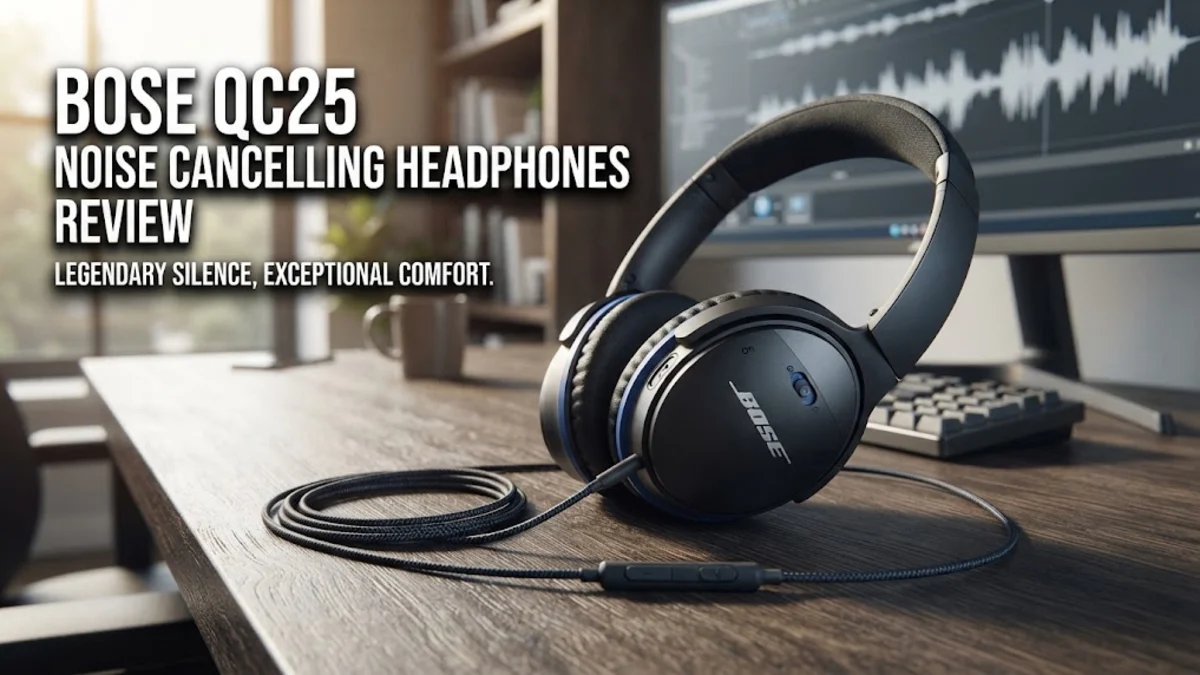
The Bose QC25 headphones represent a significant chapter in the evolution of personal audio. When they first hit the market, they redefined the expectations for active noise cancellation (ANC), proving that consumer-grade hardware could effectively silence the roar of a jet engine or the hum of an office. Today, in 2026, the QC25 persists not as a cutting-edge gadget, but as a reliable, utilitarian tool for those who value consistency over modern connectivity. While the industry has shifted almost entirely toward wireless Bluetooth implementations, the QC25 remains a testament to the effectiveness of wired analog audio coupled with high-performance signal processing.
For many, the appeal of the QC25 lies in its simplicity. You do not need to manage firmware updates, pair devices, or worry about Bluetooth interference. It is a plug-and-play solution that connects directly to any device with a 3.5mm jack. This makes the QC25 a favorite among professionals who work in audio production, frequent flyers who rely on airline entertainment systems, and students who need a distraction-free environment for long study sessions. By focusing on a single, core purpose—isolation and comfort—the QC25 provides an experience that is difficult for some feature-heavy wireless models to replicate.
Design and Build
The physical engineering of the Bose QC25 is centered around a philosophy of "wearing the music, not the hardware." The chassis is constructed primarily from high-quality, impact-resistant plastics, which keeps the total weight remarkably low. This lightweight profile is a major advantage during extended listening periods. The earcups are lined with premium, protein-leather-wrapped memory foam pads that provide a gentle but secure seal around the ears. This seal is crucial; it acts as the first line of defense against noise, providing excellent passive isolation before the active electronics even engage.
The headband utilizes a thoughtful tension system that distributes weight evenly across the crown of the head, minimizing hot spots. Users who wear glasses will particularly appreciate the soft memory foam, which exerts enough force to seal but not so much that it crushes the temples of your frames against your head. Portability is another major design triumph for this model. The earcups feature a multi-axis folding mechanism, allowing the headphones to collapse into a relatively slim, hard-shell carrying case that takes up minimal space in a backpack or carry-on luggage. While they lack the sleek, monolithic look of modern, touch-control-driven headsets, the QC25 feels rugged and capable of surviving years of daily commutes.
Key Features and Performance
The noise cancellation performance of the QC25 is its defining feature. Using a set of external and internal microphones, the headset samples environmental noise and generates an inverted phase signal. In real-world testing scenarios, this is particularly effective against low-frequency, repetitive sounds. If you are a commuter who spends time on trains, subways, or planes, the QC25 will effectively turn a chaotic, droning environment into something approaching silence. Unlike some budget ANC products that create a noticeable "hiss" or pressure sensation, the implementation here is remarkably smooth.
Audio performance is balanced and clear. The sound signature is generally described as "Bose-like," meaning it favors a natural, mid-forward approach. Vocals are clear, acoustic instruments sound detailed, and there is a pleasant warmth that prevents the sound from becoming fatiguing during long sessions. Since the audio signal is transmitted via a physical cable, there is zero data compression of the kind sometimes experienced over Bluetooth, and there is absolutely no latency—a major benefit for watching movies on a tablet or laptop. The inline remote, situated on the cable, is a reliable tactile interface. It provides physical buttons for volume and playback, which are much more responsive than the finicky touch-sensitive panels found on modern competitors. A physical switch on the right earcup toggles the noise cancellation on and off, allowing you to quickly enter "transparency" mode without needing a smartphone app.
Who It Is For (and Who Should Skip It)
This product serves a very specific segment of the market. It is an excellent choice for the traditionalist who is tired of dealing with Bluetooth connectivity issues. If you are the type of user who experiences frustration when a headset fails to sync, or who finds themselves constantly hunting for a charger, the QC25 will feel like a breath of fresh air. It is perfect for travelers who want to plug directly into the seatback entertainment system on a long-haul flight and lose themselves in a movie or album without worrying about signal dropouts.
However, you should skip the QC25 if your daily life is built around modern smartphone ecosystems. If you own a smartphone that lacks a headphone jack, you will need to contend with a dongle, which creates an extra point of failure and makes the setup less streamlined. If you require advanced features like multipoint pairing, automated voice assistants, spatial audio, or customizable sound profiles managed through a dedicated app, this headset will feel restrictive and outdated. In 2026, the absence of wireless capabilities is a significant limitation for general-purpose, everyday carry headphones.
Alternatives Worth Considering
When comparing the QC25 to modern alternatives, the differences become stark. The Sony WH-1000XM5, for example, represents the opposite end of the spectrum. It offers industry-leading noise cancellation, multi-device Bluetooth connectivity, and a battery that lasts significantly longer—all without the need for an external, disposable AAA battery. The Bose QuietComfort Ultra serves as a direct upgrade path for those who love the Bose brand and the QC25 comfort profile but need the convenience of wireless connectivity and future-proofed technology.
Sennheiser’s Momentum 4 Wireless also stands out as a strong competitor. While it lacks the iconic foldable design of the Bose, it excels in raw sound quality and battery life, making it a better choice for someone who prioritizes audiophile-grade performance and endurance. Each of these alternatives solves the problems that the QC25 inherently possesses due to its age and wired design. However, they all come at a significantly higher price, making the QC25 an attractive value proposition for the secondary market or for those who strictly prefer a wired connection.
Final Verdict
The Bose QC25 is a classic that has aged with grace. It isn't trying to be the most advanced piece of technology on your desk, and that is its greatest strength. By sticking to the fundamentals of comfort, physical isolation, and reliable audio, it provides a level of dependability that is increasingly rare in the world of consumer electronics. While the reliance on a 3.5mm jack and AAA batteries keeps it firmly in the past, it remains a fantastic option for the right buyer.
If you are someone who values function over flash, and if you have a reliable way to connect it to your primary devices, the QC25 can still provide years of service. It is a comfortable, effective, and straightforward tool that does exactly what it promises, even after all this time. If you can find a pristine unit, it represents a high-value entry point into the world of high-quality noise cancellation.