Overview
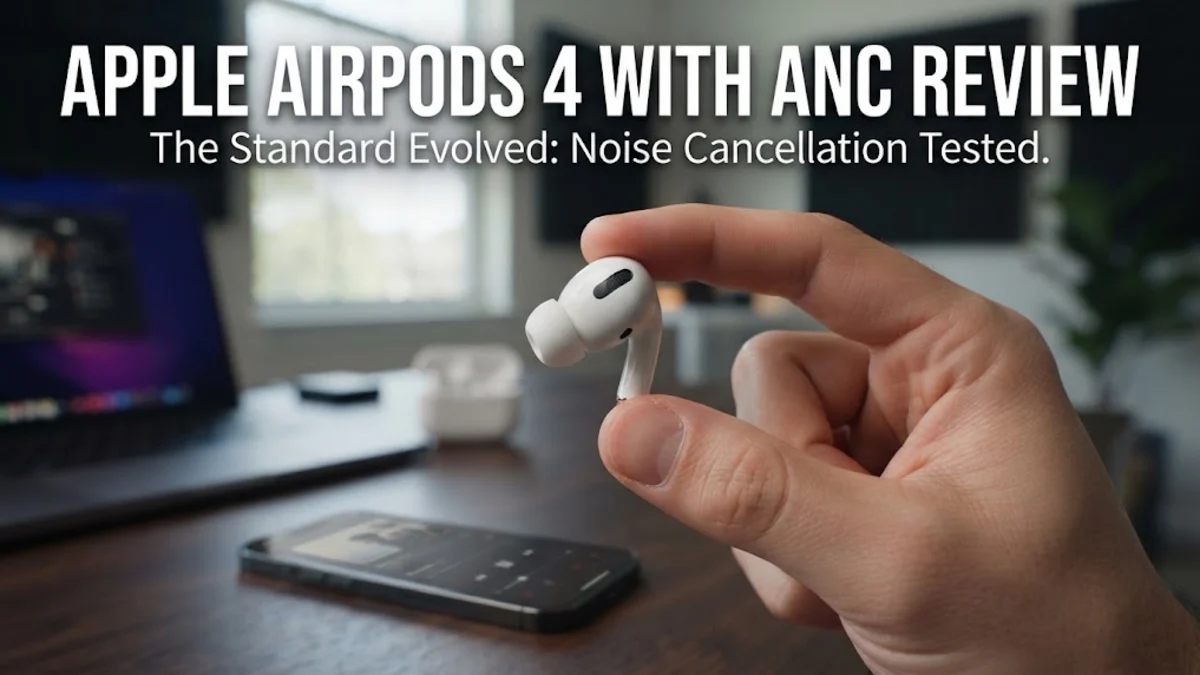
The Apple AirPods 4 with Active Noise Cancellation represent a significant evolutionary step for Apple's standard line of wireless earbuds, addressing a long-standing division in the personal audio market. For years, buyers who wanted active noise cancellation had to invest in the Pro tier, which relies on silicone ear tips to create a tight, physical acoustic seal within the ear canal. While effective at dampening environmental sound, sealed in-ear designs frequently cause discomfort, pressure fatigue, or allergic reactions for a substantial subset of listeners. The AirPods 4 with ANC change this paradigm by engineering sophisticated noise-canceling technology into a classic, open-ear acoustic architecture. Driven by the powerful Apple H2 chip, these earbuds promise improved audio fidelity, smarter contextual listening modes, and a completely redesigned shell engineered to sit securely in a broader variety of human ear shapes without requiring intrusive silicone tips.
As consumer demand for versatile, lightweight daily drivers continues to climb, these earbuds target listeners who prioritize situational awareness, breathability, and ease of use over intense in-ear isolation. Based on expert testing consensus and widespread verified buyer feedback, the AirPods 4 with ANC successfully bridge the gap between base-level convenience and flagship performance, though they must be evaluated within the inherent physical limitations of an open-ear design. Throughout this review, we examine how the H2 chip redefines open-ear audio processing, how the hardware holds up in real-world environments like busy commutes and office spaces, and whether the premium price tag over the standard AirPods 4 is justified for your daily listening habits.
Design and Build
Apple has subtly yet radically refined the geometry of the AirPods 4, utilizing extensive 3D photogrammetry and ear-shape data from thousands of scans to create a contour that rests more naturally and securely in the outer ear. For users who have traditionally found standard AirPods slipping out during movement or causing dull pressure aches during extended listening sessions, this generation provides a noticeable and welcomed improvement in daily wearability. The physical housing is slightly shorter and angled precisely to direct audio straight down the ear canal, while the stems feature a refined force sensor that allows you to manage media playback, skip tracks, and answer phone calls with a simple, tactile pinch.
The included charging case is remarkably compact, standing out as one of the smallest wireless charging cases currently available on the market, making it exceptionally easy to slip into a coin pocket or small bag. Beyond its diminutive size, the case features a built-in speaker for Find My alerts, letting you emit a locator tone if you misplace them around the house. It also supports modern charging flexibility: you can juice it up via USB-C, place it on a Qi-certified wireless charging pad, or snap it onto an Apple Watch magnetic charging puck. Furthermore, both the individual earbuds and the charging case carry an IP54 dust, sweat, and water resistance rating, ensuring they are resilient enough to handle rigorous gym workouts, sweaty runs, and unexpected downpours during your daily outdoor commute.
Key Features and Performance
At the absolute heart of the AirPods 4 with ANC is the Apple H2 chip, an advanced silicon architecture enabling powerful computational audio algorithms that process soundscapes in real time. Because open-ear headphones naturally allow a significant amount of ambient sound to bypass the housing, the H2 chip works overtime to phase-cancel background noise through dual outward-facing microphones. Adaptive Audio dynamically blends Transparency mode and Active Noise Cancellation based on your surroundings, automatically scaling down disruptive droning sounds while preserving critical conversational cues or emergency sirens. Features like Conversation Awareness instantly lower your media volume when you start speaking to someone, shifting convenience to a new level for casual office chats or retail transactions.
Sound quality is remarkably crisp, featuring custom high-amplitude drivers and a high dynamic range amplifier designed to minimize distortion across frequencies. Low frequencies have more punch, warmth, and depth than previous non-pro generations, while vocals and mid-range instruments remain articulate and clear. Spatial Audio with dynamic head tracking further elevates media consumption, turning standard stereo mixes into immersive soundstages that anchor dialogue to your Apple device or television. Battery life is rated at up to 4 hours of continuous listening time with ANC turned on, extending up to 30 hours total when factoring in the supplementary charges stored in the case. Quick charging capabilities deliver roughly an hour of listening time from just a five-minute charge, ensuring you are rarely left stranded without power.
Who It Is For (and Who Should Skip It)
These earbuds are tailor-made for iPhone, iPad, and Mac users who actively detest silicone ear tips, suffer from ear canal fatigue, or simply prefer a breathable, pressure-free fit combined with the effortless pairing convenience of the Apple ecosystem. They are fantastic for open-plan office environments, light urban commuting, and users who need to remain situationally aware while walking or jogging outdoors. If you want the smart features of Apple's ecosystem without plugging your ears up completely, this is the exact product you have been waiting for.
Conversely, you should skip them if you require absolute silence on long-haul airplane flights, noisy train rides, or heavy industrial work environments. Because physics dictates that open-ear designs cannot block heavy low-frequency rumble as effectively as sealed in-ear alternatives, airplane cabin noise will still leak through. Android and Windows users should also look elsewhere, as much of the H2 chip's advanced functionality—such as seamless device switching, personalized spatial audio calibration, and hands-free Siri commands—requires an Apple host device to function properly, rendering them an overpriced standard pair of earbuds on non-Apple hardware.
Alternatives Worth Considering
If you prefer a traditional silicone seal for maximum passive and active noise isolation, the Sony WF-1000XM5 remains the industry standard for sheer audio fidelity and deep noise cancellation packed into a miniature in-ear footprint. For Samsung users or Android loyalists seeking rich EQ customization and robust cross-platform ANC performance, the Samsung Galaxy Buds 3 Pro offer a compelling high-end alternative with stem-based controls and futuristic LED lighting accents. Alternatively, if you want Apple features on a tighter budget and do not care about noise cancellation at all, the standard AirPods 4 drop the price significantly while retaining the core ergonomic upgrades, acoustic driver architecture, and H2-powered connectivity of their more expensive sibling.
Final Verdict
The Apple AirPods 4 with Active Noise Cancellation are a genuine technical milestone, successfully introducing functional noise cancellation to an open-ear form factor that many engineers deemed too leaky for effective ANC. While basic physics means they cannot compete with sealed in-ear monitors for raw environmental isolation, their superior ergonomic comfort, seamless ecosystem integration, and surprisingly capable computational ANC make them an elite choice for Apple users who prefer a tip-free listening experience.