Overview
In the world of high-end kitchen appliances, few machines carry the same level of cult-like devotion and heritage as the Ankarsrum Assistent Original. Manufactured in the small town of Ankarsrum, Sweden, since 1940, this stand mixer has maintained a remarkably consistent design philosophy while evolving its internal mechanics to meet modern standards. In 2026, it remains a standout alternative to the planetary-action mixers that dominate the North American and British markets. Unlike the standard mixers where a whisk or hook orbits a stationary bowl, the Ankarsrum rotates the bowl itself against stationary or self-spinning tools. This architectural difference is not just a quirk of design; it is a fundamental shift in how ingredients are incorporated, particularly heavy doughs. For those who have found themselves frustrated by the straining motors or bouncing heads of traditional mixers, research into the Ankarsrum suggests a more stable, industrial-strength solution for the home kitchen.
Design and Build
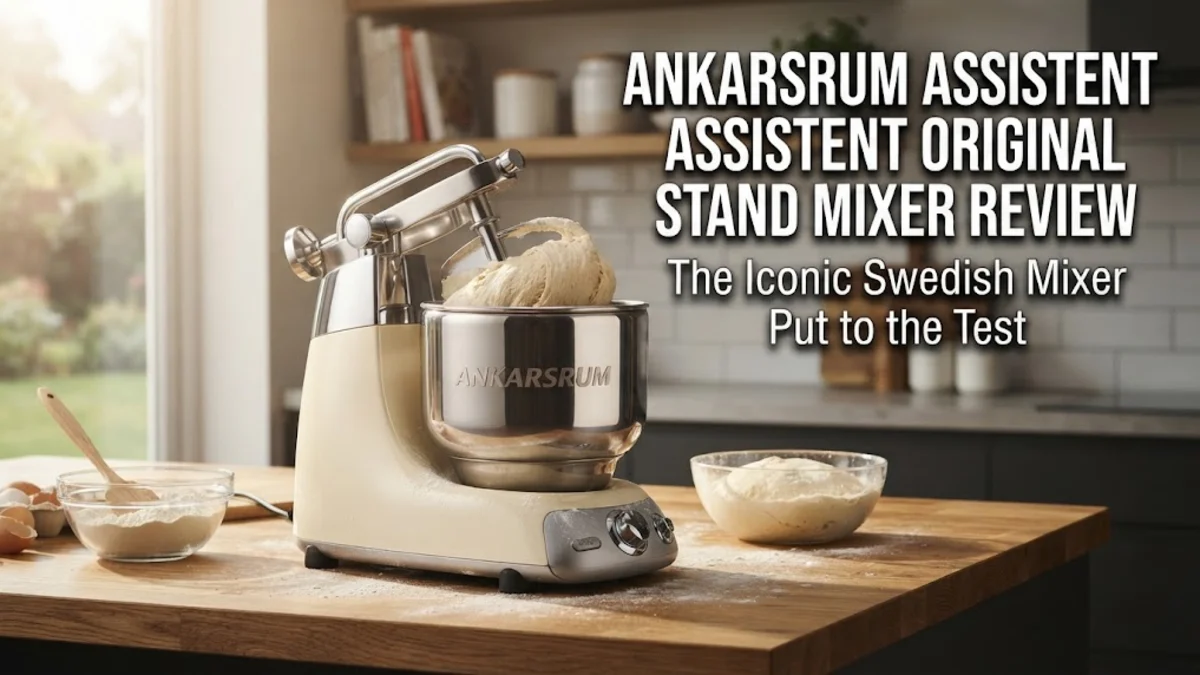
The first thing you notice about the Ankarsrum Assistent Original is its unusual silhouette. It is shorter and wider than most competitors, standing only about 14 inches tall. This low profile is a significant advantage for kitchens with low-hanging upper cabinetry. The base is constructed from heavy die-cast aluminum, providing a weighted foundation that prevents the machine from 'walking' across the counter during high-speed tasks. One of the most striking design choices is the bottom-drive motor. By placing the motor in the base and driving the bowl from below, Ankarsrum has eliminated the top-heavy nature of tilt-head mixers. This design also allows for an open-top bowl, making it incredibly easy to add ingredients like flour or liquids without having to pause the machine or navigate around a bulky mixer head.
The build quality is frequently cited by experts as best-in-class. There are no plastic shrouds or thin metal sheets here; every knob and arm feels deliberate and robust. The machine comes standard with two bowls: a massive 7-liter stainless steel bowl for dough and large batches, and a 3.5-liter BPA-free Tritan plastic bowl for whisking and lighter tasks. In an era where many appliances are designed with planned obsolescence in mind, the Ankarsrum is built for decades of service, backed by a manufacturer's confidence that is reflected in its lengthy warranty.
Key Features and Performance
The performance of the Ankarsrum Assistent Original centers on its unique dough-kneading attachments: the dough roller and the dough hook. For most bread bakers, the roller is the star of the show. When paired with the scraper, the roller mimics the action of a human hand kneading dough against the side of the bowl. Verified buyer feedback consistently highlights that this method develops gluten more gently and thoroughly than a traditional planetary hook, which can sometimes just 'punch' the dough. For exceptionally heavy or large batches—up to 11 pounds of dough at once—the stainless steel dough hook provides the necessary leverage to keep the motor running cool and efficient.
Speed control on the Ankarsrum is stepless, allowing for precise adjustments rather than being locked into 10 preset notches. It also features a built-in timer (up to 12 minutes), which is a boon for recipes requiring specific kneading durations. While it excels at bread, the secondary whisking bowl uses a more traditional planetary gear system driven by the same motor. This allows it to handle delicate tasks like whipping a single egg white or creating a light sponge cake with the same efficiency as a specialized pastry mixer. However, it is important to note that the machine’s power is biased toward torque rather than raw speed, making it a marathon runner rather than a sprinter.
Who It Is For (and Who Should Skip It)
The Ankarsrum Assistent Original is specifically designed for the 'power user' of the kitchen. If your weekly routine involves baking multiple loaves of sourdough, dense rye bread, or large batches of cookies for events, this machine has no equal in the consumer space. Its 7-liter capacity and high-torque motor mean it can handle quantities that would cause most residential mixers to overheat or strip their gears. It is also an excellent choice for those who value longevity and repairability; it is not uncommon to find households in Europe still using versions of this machine from the 1970s.
Conversely, this may not be the right choice for the occasional baker or those who prioritize simplicity above all else. The rotating-bowl system requires a different sequence of adding ingredients (liquids usually go in first) and a bit of 'babysitting' during the first few uses to learn how to adjust the arm tension. If you only bake the occasional batch of cupcakes or a single loaf of white bread, the price tag and the learning curve might be difficult to justify. Furthermore, while it is shorter than other mixers, it does have a larger footprint on the counter, which might be a concern for those in compact urban apartments.
Alternatives Worth Considering
For those who prefer the traditional planetary action, the KitchenAid Pro Line 7-Quart remains the primary competitor. It offers a more familiar user interface and a vast ecosystem of front-hub attachments. However, users often find that for very stiff doughs, the KitchenAid can struggle more than the Ankarsrum. Another high-end option is the Wolf Gourmet High-Performance Stand Mixer. It features a very powerful motor and a sophisticated bowl-lift design, though it lacks the sheer volume capacity of the Ankarsrum’s 7-liter bowl.
In the UK and Australian markets, the Kenwood Titanium Chef Patissier XL is a formidable rival. It includes modern features like an integrated scale and a warming bowl for proving dough. While the Kenwood is technologically more advanced in terms of digital features, the Ankarsrum is generally considered more mechanically durable for heavy-duty kneading over long periods.
Final Verdict
The Ankarsrum Assistent Original Stand Mixer remains a masterclass in mechanical engineering as we move through 2026. It eschews the digital bells and whistles found in many modern appliances in favor of raw power, capacity, and durability. While the initial investment is significant and the operating method is unique, the results it produces—especially in bread making—are professional-grade. It is a machine that rewards the baker who takes the time to understand its rhythm. For those committed to the craft of baking, it isn't just a kitchen tool; it's a generational appliance that likely will be passed down to the next set of hands.